

How to Measure Forklift Forks
Four measurements identify any replacement fork: carriage height (which gives you the class), then fork length, width, and thickness. Carriage height is the one that determines fit — 16" is Class 2, 20" is Class 3, 25" is Class 4 — and the other three determine capacity and reach. Here's how to take each one.
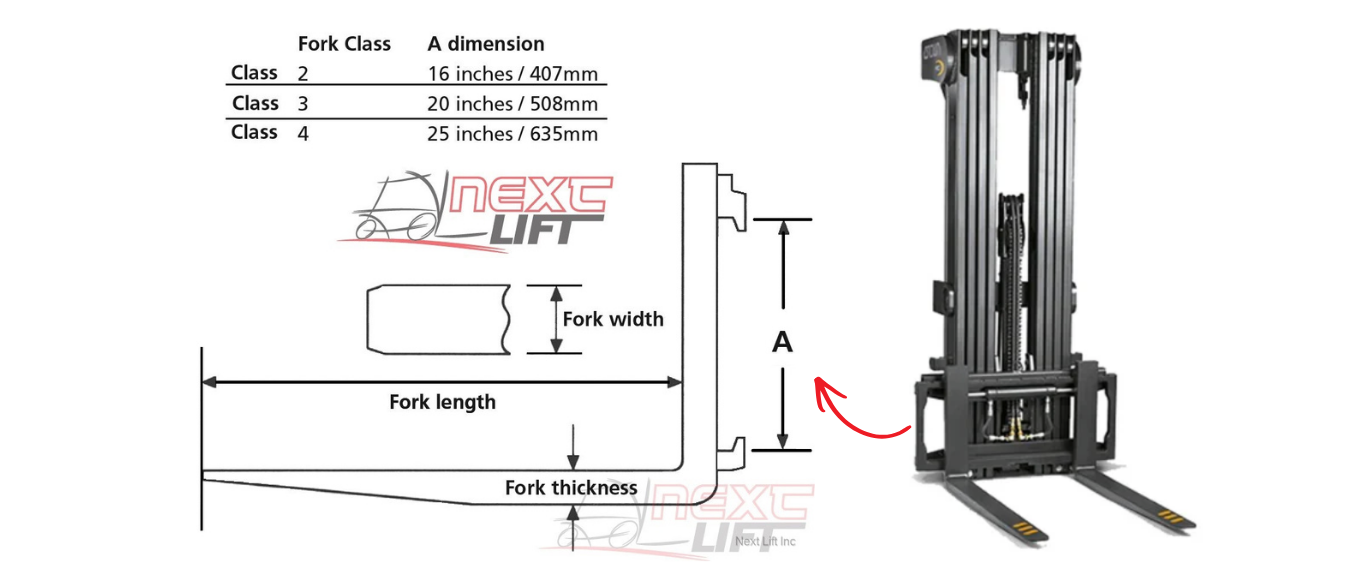
Step 1: Measure your carriage height to find your class
The carriage is the rectangular frame on the front of your forklift that the forks hang on. Lower the mast fully, shut the truck off, and measure the vertical distance from the top edge of the upper carriage bar to the bottom edge of the lower carriage bar.
| Your measurement | Fork class | Typical truck capacity |
|---|---|---|
| 16" | Class 2 | 2,200 – 5,500 lb |
| 20" | Class 3 | 5,500 – 11,000 lb |
| 25" | Class 4 | 11,000 – 17,600 lb |
These sizes are set by the Industrial Truck Association under ISO 2328, which is why a Class 3 fork from any maker fits a Class 3 carriage on any truck brand — Toyota, Hyster, Yale, CAT, Clark, and the rest.
Two common exceptions — measure, don't assume from capacity:
- Newer Hyster and Yale trucks in the 10,000–11,000 lb range often carry a Class 4 carriage, even though that capacity would normally suggest Class 3. If you run one of these, expect a 25" measurement.
- Trucks with a 4-stage (quad) mast generally run one carriage class smaller than their capacity suggests. A 6,500–7,000 lb quad-mast truck typically has a Class 2 carriage, not Class 3 — the extra mast stage takes up capacity that the carriage size no longer reflects.
This is why the tape measure is the final word: capacity narrows it down, but only the carriage height confirms it.
Getting 19", 22", 23", or another odd number? You might have a CASE, John Deere, or other manufacturer that doesn't follow ITA standards. Email a photo of your carriage to sales@nextliftforks.com and we'll identify what fits.
Forks on a round bar held by a pin instead of hooks? That's a shaft mount system — class doesn't apply. Measure the shaft diameter, fork spread, and drop instead, and see our shaft mount forks.
Not sure which class your truck needs before measuring? Start with What Class Fork Do I Need?
Step 2: Measure fork length
Length runs along the top face of the blade, from the front of the shank (the vertical part) to the tip. Measure the top surface, not the tapered underside — the taper makes the bottom read short.
Choosing a new length instead of matching old forks? The rule: forks should reach at least two-thirds under your longest load. 42" and 48" handle standard 40"–48" pallets. Go 60"–96" for lumber, sheet goods, and double-length loads. We stock standard taper through 120".
Longer isn't automatically better — tips protruding past the load can strike racking, product, or a second pallet behind the one you're lifting.
Step 3: Measure width and thickness
- Width is across the top face of the blade — commonly 4", 5", 6", or 7".
- Thickness is the vertical dimension of the blade, measured on the shank, not the blade. The blade thins toward the tip by design (that's the taper), and worn forks thin further — the shank keeps its original thickness. Common sizes: 1.5", 1.75", 2".
Width × thickness sets the fork's strength. Every Next Lift product page lists the pair capacity at a 24" load center for its exact cross-section.
Replacing worn forks? If the blade heel has worn 10% below original thickness, the fork has lost roughly 20% of its capacity and should be retired — measure the shank to know what the original thickness was.
Step 4: Understand load center before picking capacity
Fork capacities are rated per pair at a 24" load center — the load's weight centered 24" out from the shank, which matches a standard 48" pallet. Carrying loads whose center of mass sits farther out reduces real-world capacity.
Two numbers limit every lift: the fork rating and the truck's data plate rating. The lower number always governs. A pair of forks rated 6,800 lb on a truck rated 5,000 lb still lifts a maximum of 5,000 lb.
Quick reference: what to write down before ordering
- Carriage height → class (16" / 20" / 25")
- Fork length (top face, shank to tip)
- Width (across the top)
- Thickness (at the shank)
- What you lift and how far out its weight sits
With those five, any product page on this site tells you in seconds whether the fork fits. Or skip the homework: email a photo of your carriage and your data plate to sales@nextliftforks.com or call 937-387-8140 — we'll match you same-day.
Shop by class
- Class 2 forklift forks — 16" carriage
- Class 3 forklift forks — 20" carriage
- Class 4 forklift forks — 25" carriage
- Full taper & polish forks — for thin or fragile loads
- Shaft mount forks — pin-type carriages
Free shipping to the lower 48, 1-year warranty, and most forks deliver in 3–5 business days. Contact us with any questions.